Contents
Finding the right location to open a business usually takes weeks and costs several thousand euros in consulting fees. Yet the data exists. It's freely accessible. What was missing was a tool capable of interpreting it for you, in seconds. That's exactly what SMAPS-AI does: you ask a question in natural language, and it answers like a seasoned location-analysis expert.
What you'll learn
- What a location study is and why it's essential before opening
- How to generate an isochrone-based catchment area in seconds
- How to analyze the demographic profile of a neighborhood without touching a GIS
- How to identify local competition in real time using official registers
Why a classic location study takes so long
Opening a second point of sale is a multi-year commitment. Yet most founders face the same wall: either they outsource the study to a specialized firm (count €3,000 to €8,000 and 4 to 6 weeks), or they attempt to figure it out with complex GIS tools that require several days of training.
The problem isn't a lack of data. France's INSEE publishes detailed statistics at the IRIS scale (geographic units of ~2,000 inhabitants). Business registers list every potential competitor. Mapping APIs compute isochrones to the minute. All of this is public, free, and up-to-date.
What was missing was an intermediary capable of making this data accessible to someone without GIS training. That's SMAPS-AI's role.
The SMAPS-AI approach: ask, get the analysis
SMAPS-AI works as a conversational location-analysis assistant. You don't need to know what a shapefile, a map projection, or a spatial SQL query is. You write what you want to know, in plain language, and the tool produces the analysis.
A concrete example: Marie, an artisan baker in Rennes (France), wants to open a second location. She has identified three candidate neighborhoods but doesn't know which has the best potential. Here's how she proceeds with SMAPS-AI in less than 10 minutes.
Step 1 — Define the catchment area in natural language (2 minutes)
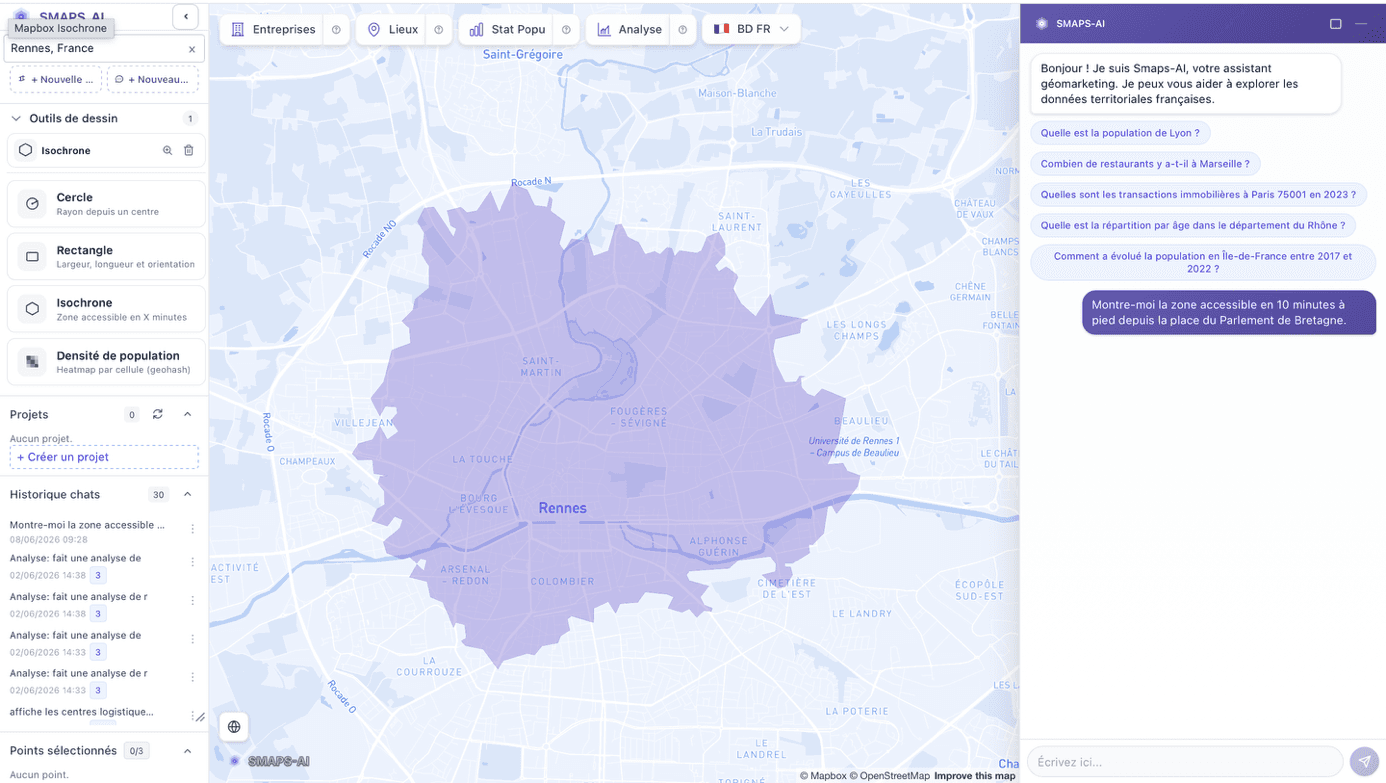
Marie zooms in on Rennes in the interface and types:
"Show me the area reachable in 10 minutes on foot from Place du Parlement de Bretagne."
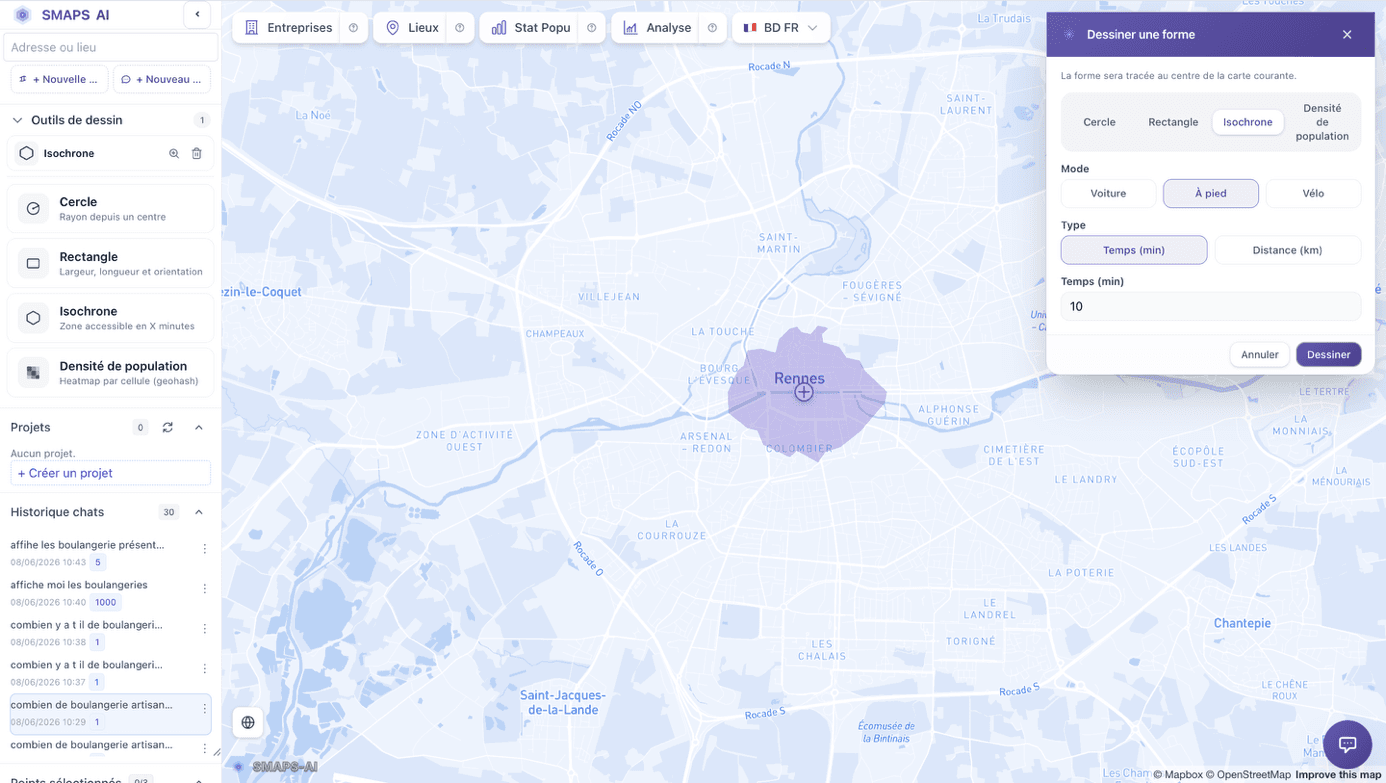
SMAPS-AI instantly generates a precise pedestrian isochrone, powered by real street data. No circle approximation, no as-the-crow-flies calculation: the zone reflects actual travel times, accounting for streets, crosswalks, and obstacles.
She can refine:
"And in 5 minutes by bike?"
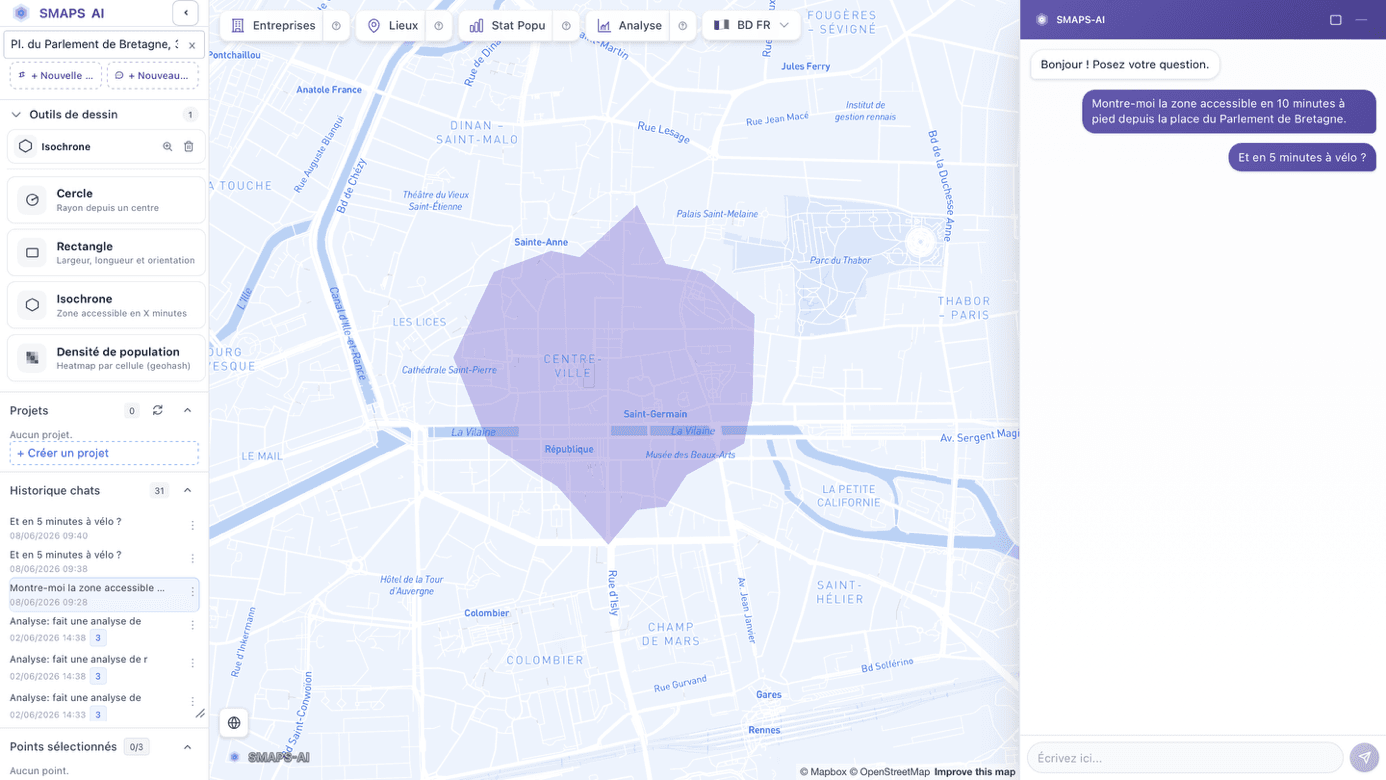
In two questions, Marie has two overlapping catchment perimeters on the map. What a consultant would produce after several hours of work in QGIS.
You can do the same for any address in France on app.smaps-ai.com.
Step 2 — Analyze the neighborhood's demographic profile (3 minutes)
A catchment area without a customer profile is a map without a legend. Marie wants to know who lives in her three candidate zones.
She asks:
"What is the profile of residents in my catchment area: age, income, household composition?"
SMAPS-AI queries INSEE data at the IRIS scale and synthesizes the results: median age, share of families with children, average household income, share of working-age population, population density.
For Place du Parlement, the data reveals a young population (15–44), mid-to-upper income, a high share of singles and young childless couples. For another peripheral neighborhood tested in parallel, the profile is the opposite: large families, more modest income, high density.
These two profiles don't match the same needs. A premium artisan bakery positions itself differently depending on the neighborhood. Marie knows this now, in 3 minutes, backed by official data.
Step 3 — Identify local competition (3 minutes)
Knowing your potential market is good. Knowing how many competitors already operate there is better.
Marie types:
"Show me the bakeries in this area."
SMAPS-AI queries business registers (SIRENE data) and active establishment data in real time. It plots competing points of sale on the map, with their NAF code (French equivalent of NAICS) and address.
For the Parlement area, 8 bakeries are already present. For a third neighborhood tested in parallel — Beauregard, in full demographic expansion — only one bakery exists for a rapidly growing population.
The diagnosis is self-evident.
Step 4 — Score the zones and make the decision (2 minutes)
Marie now has three comparable analyses:
| Criterion | Place du Parlement | Thabor | Beauregard |
|---|---|---|---|
| Catchment (10-min walk) | ~4,200 ppl | ~3,800 ppl | ~6,100 ppl |
| Target profile | ✔ Good | ✔ Very good | ✔ Excellent |
| Direct competitors | 8 | 3 | 3 |
| Overall score | Average | Low | Strong |
Beauregard wins: dense and growing population, family profile prone to buying quality products, near-absence of artisan competition.
This entire analysis in less than 10 minutes, with verifiable public data, no GIS training, and no consultant.
What SMAPS-AI does not replace
Let's be honest: SMAPS-AI does not replace a field visit. Data does not capture the real pedestrian flow in front of a storefront, the vibe of a neighborhood at 7am, or visibility from the street. The tool gives you the best possible analytical baseline for making an informed decision — the final call is still yours.
Conclusion
A location study is no longer reserved for large chains with in-house location-analysis teams. With SMAPS-AI, any founder can access the same analytical quality in minutes: isochrone catchment area, detailed INSEE profile, competitor mapping.
Marie took 10 minutes to identify Beauregard as the best opportunity. A consultant would have charged her €4,000 for the same conclusion, three weeks later.
Run your first location study free on SMAPS-AI — no GIS expertise required.
app.smaps-ai.com